

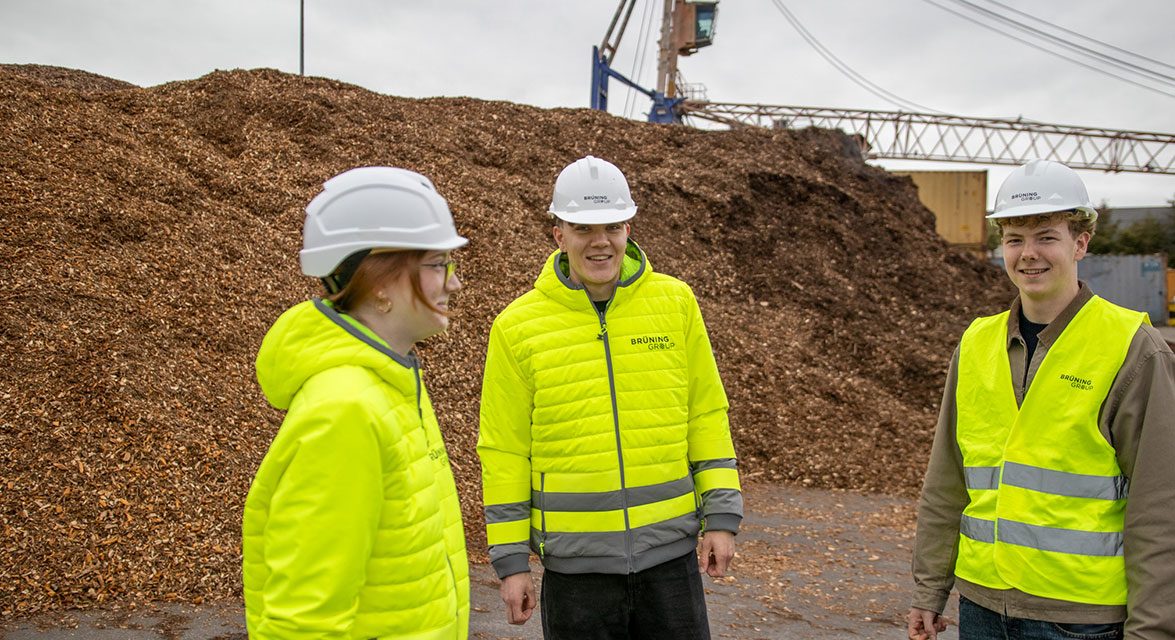
Where a wide range of biomass assortments converge, new logistical opportunities arise: with a terminal at the Port of Bremen, the Brüning Group is providing around 10,000 square metres of space for handling roundwood, wood chips, and waste wood. This involves bundling the activities of several business units to make targeted use of synergies.
BRÜNING GROUP BUNDLES BIOMASS PRODUCT RANGES
A particular focus is on wood chips, with up to 25,000 tonnes expected to be handled at the terminal each year. The location also offers advantages for waste wood. By being able to stockpile material on site, we ensure greater security of supply and can thus respond flexibly to the needs of our customers and business partners. The location has already proven its value in the round wood business: the Brüning Group has been calling at the Port of Bremen regularly since December 2025. Over the past eleven months, a total of around 32,000 tonnes have been handled on this route, spread across 13 vessel calls.
A HOME GAME AT THE PORT OF BREMEN
One key advantage of the terminal is the ability to link incoming freight with outgoing deliveries. By intelligently combining freight flows, transport routes can be organised more efficiently and cost savings achieved – a principle that has already proven its worth in road transport. At the same time, the different units involved benefit from shared handling and logistics infrastructure. And all of this is right on our doorstep, as the terminal’s proximity to the Brüning Group’s headquarters in Bremen’s Überseestadt district is another advantage. “We are particularly pleased to be able to establish a transhipment operation right on our doorstep – it’s practically a home game,” explains Kevin Sammann, Head of the Unit Fresh Wood Biomass.
A NEW HUB FOR LOGISTICAL SYNERGIE
By reactivating the port site, the Brüning Group is building on previous activities at the location in 2020 and 2023. Its renewed utilisation enables us to centralise the expertise of our units and bring our various products together at a single hub. This helps strengthen value creation throughout the supply chains.